Physical Address
304 North Cardinal St.
Dorchester Center, MA 02124
Physical Address
304 North Cardinal St.
Dorchester Center, MA 02124
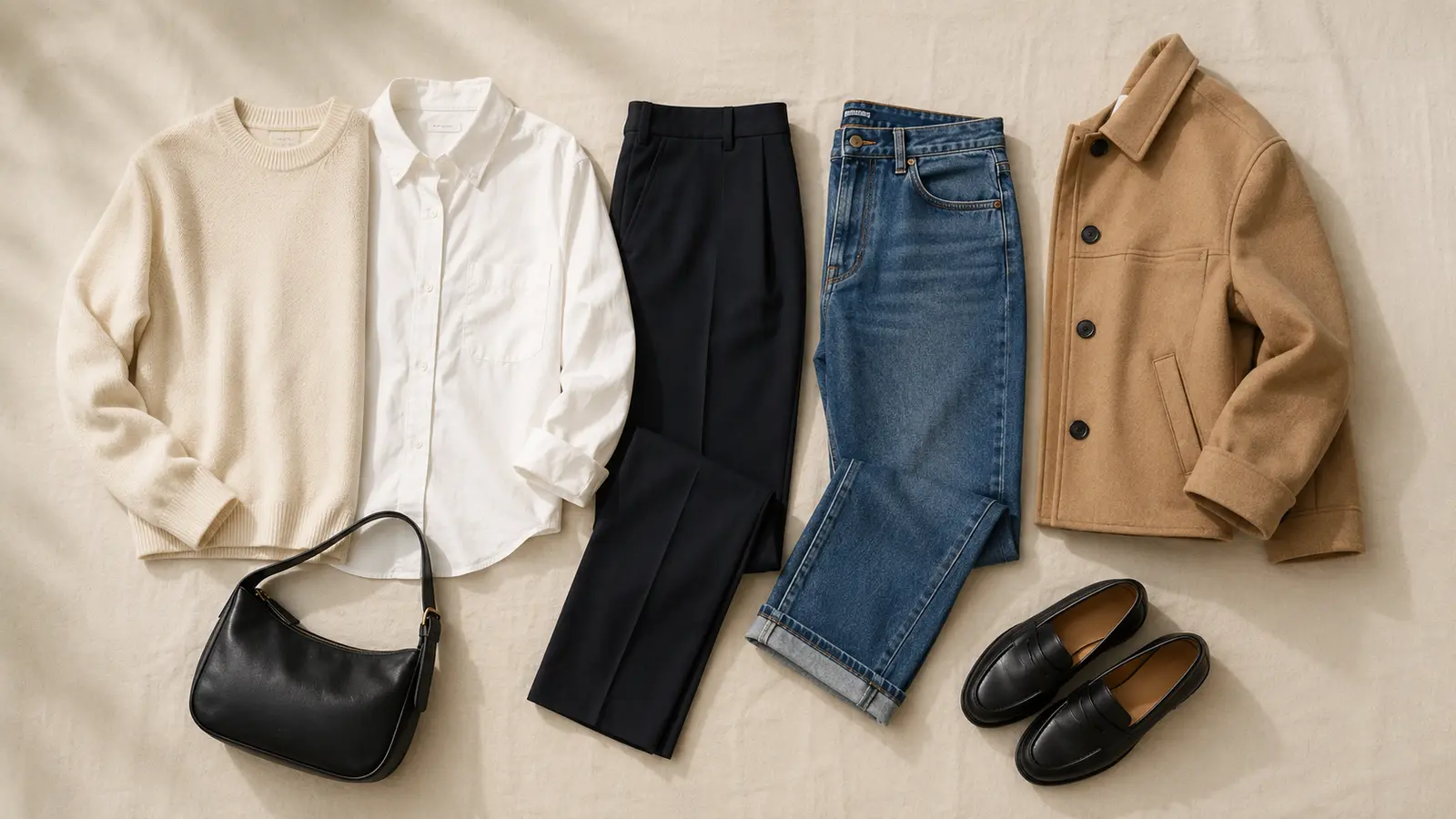
A useful capsule starts with the clothes you already wear. Here is a practical way to build one, test it, and find out what you’re actually missing before you shop.
Learning how to build a capsule wardrobe starts with the life you actually live—not a universal list of must-have clothes.
THE SHORT ANSWER
A capsule wardrobe is a deliberately limited group of clothes that work together and cover your real routines. Start with 13–19 core pieces: 5–7 tops, 3–4 bottoms, 2–3 layers and 2–3 pairs of shoes. Build it from clothes you already own, wear it for two weeks, then buy only what the trial proves you are missing.
A capsule wardrobe is a compact, coordinated selection of clothing that combines into many outfits. The goal is not to own as little as possible. It is to make more of your closet usable—so the pieces fit your life, work with one another and actually get worn.
You will see strict formulas online: 10 pieces, 30 pieces, 37 pieces or a fixed list of classics. Ignore the numbers and keep the method. Someone working from home in Florida needs a different capsule from someone commuting through a Toronto winter. Dress code, climate, laundry access, mobility, personal taste and budget all move the answer.
This guide is written around a women’s wardrobe, but the compatibility principles apply to any closet.
The fastest way to build the wrong capsule is to shop for an imagined life. Start with a two-week snapshot of what you actually do.

Take a mirror photo each morning, or keep a note. Record what you reached for, what felt comfortable and what made getting dressed difficult. This gives you evidence from your own routine instead of relying only on a generic essentials list.
Start with clothes that fit you today, suit your routine and have already earned repeat wear. Don’t begin by discarding. Put the uncertain pieces in a box and reassess after the trial.
Pick one or two foundation colors you already own—black, navy, brown, gray or cream—then add two or three colors or prints you like. Neutrals are useful; an all-neutral wardrobe is not required.
The test is simple: can most of your tops work with more than one bottom?
Your capsule needs functions, not “timeless” items. A structured knit can do the job someone else assigns to a blazer. Weatherproof boots may matter more than loafers.
Before a piece enters the capsule, try to build three complete outfits with it using clothes you already own. If you cannot, set it aside and ask whether it still fills a necessary role.
Single-purpose gear—such as a serious winter coat or an interview outfit—can earn its place on function alone.
Wear the selected group for two weeks. Don’t force every piece into rotation. Note what you miss, what you avoid and where laundry timing leaves you short.
At the end, bring back anything you genuinely missed and remove what repeatedly failed. Your first capsule is a draft.
Write the gap as a problem before you shop:
“I need a washable layer for a cold office that works with three bottoms I already own.”
That is a useful brief. “I need a cardigan” is not.
Most capsule guides tell you to choose pieces that coordinate and then stop. At The Wear Brief, we use four practical checks to explore why a combination may feel cohesive—or why it may need adjustment.
These are flexible styling tools, not universal rules. Personal preference can override any of them.
As a working exercise, give each piece a score from 1 to 5:
Pieces close in formality are often easier to combine. A wider gap can create an intentional high-low look, but a third piece may help connect the two. Use the score to diagnose a combination, not to forbid it.
Warm neutrals—such as cream, camel, chocolate, warm beige and some olives—can create one kind of palette. Cooler whites, grays, navy, charcoal and black can create another.
Building around one temperature may make coordination easier, but mixing warm and cool neutrals can also work when the contrast is deliberate. Treat temperature as a clue, not a restriction.
Pairing a loose piece with a closer-fitting one can create clear contrast. Two loose pieces may feel more intentional with a tuck, a defined waist or a structured layer—if that suits the look you want.
Two fitted pieces create a different, sharper silhouette. None of these proportions is mandatory.
The point where a trouser or skirt ends changes how much of the shoe is visible and where the eye sees a horizontal break.
Try the complete outfit with the footwear you plan to wear. A full-length hem, cropped hem and ankle boot can each work; compare the proportions in a mirror or photograph and choose the effect you prefer.
Build this before you buy anything. Take five tops and three bottoms from your existing closet. Put the tops down the side and the bottoms across the top, then mark every combination as:
The grid helps identify which pieces carry the wardrobe, which combinations need adjustment and what—if anything—is actually missing.
Illustrative example: The grid below demonstrates the method with a fictional starting wardrobe. It is not a documented personal wardrobe trial.
| Top | Indigo Jeans (F3, Cool) |
Black Trousers (F4, Cool) |
Olive Wide-Leg Pants (F3, Warm) |
|---|---|---|---|
| White Cotton Tee (F2, Cool) |
YES | FIX — Add a polished layer | FIX — Try cream instead |
| Cream Silk Blouse (F4, Warm) |
YES — Intentional high-low | FIX — Add a black layer | YES |
| Black Fine-Knit Sweater (F3, Cool) |
YES | YES | NO |
| Navy Striped Top (F3, Cool) |
FIX — Add contrast | YES | NO |
| Gray Oversized Sweatshirt (F1, Cool) |
YES | NO | FIX — Define the waist |
How to read the result. For this The Wear Brief exercise, a higher number of clear yeses suggests that the selected pieces are easier to combine. A lower number does not prove that you need more clothes; it shows where to look more closely. In this illustrative grid, the olive wide-leg pants receive several “fix” or “no” marks because their temperature and volume differ from much of the sample wardrobe. Possible responses include restyling them, moving them outside the core capsule, or testing a different bottom—not automatically buying more tops.
The black tailored trousers behave differently: they combine with several pieces but may feel more formal than the casual tops. In this fictional example, first test an existing structured layer. If none works and the need appears repeatedly, a lightweight blazer or structured cardigan could be a useful candidate—after fit, care and return terms are checked.
That is the whole point of the grid. It converts a vague feeling of having nothing to wear into one specific purchase, or into no purchase at all.
If a blank page feels difficult, use these numbers as a starting experiment for weekly laundry and a mixed office-and-home routine. They are not a universal target.
That is roughly 13–19 core pieces before accessories, underwear, sleepwear, activewear, uniforms and special-occasion items, which are easier to track separately.
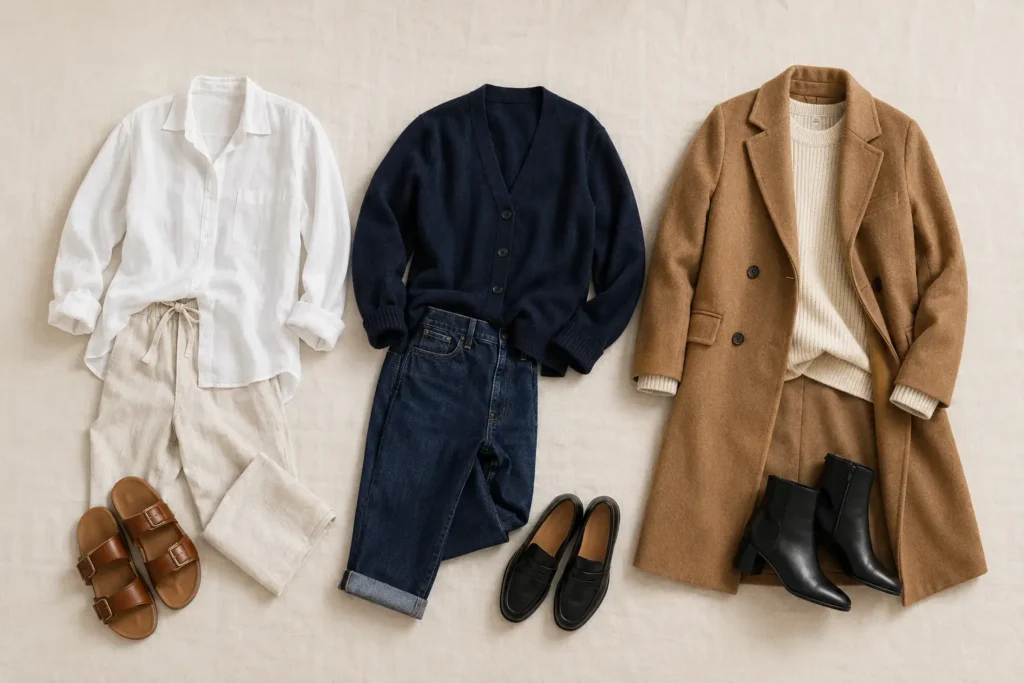
If you live with large seasonal changes, rotation may be more practical than one fixed year-round capsule. Keep a stable core — perhaps jeans, indoor layers, basic tops and everyday shoes — and rotate climate-specific pieces around it.
One caution: a fiber name alone does not describe the whole garment. Two garments that both contain linen may feel and perform differently because of blend, weave, weight, lining and construction. Check the full composition and care instructions rather than treating one fiber name as a performance guarantee.
A capsule depends on repeat wear, so online purchases deserve a slower check. Before you order:
Don’t shop until the trial produces a specific gap. If the pieces already cover your week, the most useful next step is no purchase at all.
THE WEAR BRIEF TAKEAWAY A good capsule wardrobe is not the smallest or the most photogenic one. It is the one that makes your normal week easier, works with your climate, and gives every new purchase a clear reason to exist.
How many pieces should be in a capsule wardrobe? If a number helps you begin, try the 13–19-piece framework in this guide and adjust it. There is no universal requirement — your laundry schedule, seasons, dress code and appetite for variety matter more than a popular number.
Should I throw away clothes that aren’t in the capsule? No. Box the uncertain and off-season pieces, then reassess after the trial. Donate, resell or recycle only once you’re sure and the item’s condition suits that route.
How long before a capsule feels settled? It may take several trial cycles. Reassess after each cycle and change only what your actual routine shows you is missing or unused.
Editorial note: this article offers general wardrobe-planning guidance. Prices, size charts, sellers, shipping and return policies change; confirm current details with the retailer before buying.
Images in this article are AI-generated editorial images.